
.jpg)
Ecommerce conversion rate optimisation is what turns consumer interest into profit, and the numbers show just how much room for improvement there is.
According to data from Adobe, the average ecommerce conversion rate across all retail niches is just 3.65%, meaning that only around 4 out of every 100 visitors are taking the desired action and making a purchase. Meanwhile, the average cart abandonment rate sits at around 70.22%, showing a major growth opportunity for brands who are able to streamline the shopping experience and minimise barriers.
Whether you’re an Amazon-only brand, D2C, or both, ecommerce conversion rate optimisation is a crucial part of any sustainable ecommerce strategy. In this guide, we’ll explore what ecommerce conversion rate really means, explore how it differs between Amazon and other retail channels, and some of the detailed, high-impact tactics you can use to drive real uplift.
What is Ecommerce Conversion Rate Optimisation?
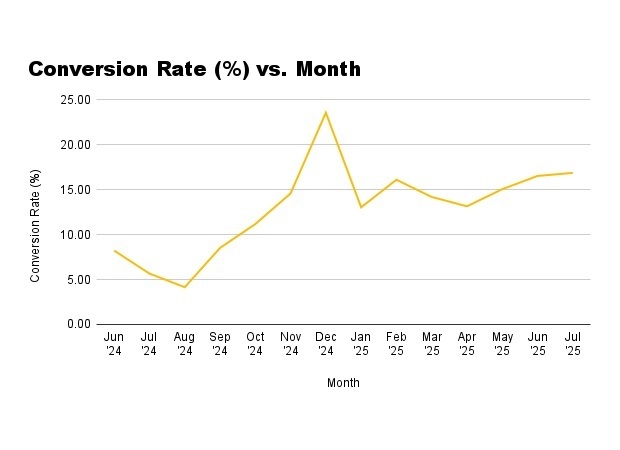
Our content optimisation project for confectionary brand Monty Bojangles achieved a 31% increase in conversion rate and a 149% increase in purchases in just 3 months - check out the full case study here.
Ecommerce conversion rate optimisation (or simply CRO) is a systematic practice of increasing the proportion of visitors who complete a purchase after encountering your brand online, by increasing a product’s relevance to their needs or removing points of friction.
Broadly, ecommerce CRO drives are focussed on making changes to the customer experience, which can often depend on control of the platform itself (e.g. an owned D2C ecommerce site). However, even as a brand selling on Amazon, there are a number of seemingly small changes that can have a major impact on your long-term sales.
Successful CRO for ecommerce isn’t about guesswork, and is instead driven by data, hypotheses, and iteration.
The key pillars of ecommerce conversion rate optimisation are:
Quantitative Analytics: Funnel analysis, breakdowns by traffic source, search query behaviour, segmentation by location and device, and assigning revenue per visitor.
Qualitative Insights: Session recordings, heatmaps, usability testing, and customer feedback, all used to unearth customer pain points that might be hard to identify using basic analytics.
Experimentation: Articulating hypotheses, running controlled A/B testing, and using statistically-informed methods to choose winning marketing methods.
When it comes to conversion rate optimisation for ecommerce, it’s important to bear in mind some key guiding principles, including:
Benchmarks Vary by Niche
Though the global average ecommerce conversion rate always hovers around the low single digits, benchmarks can vary greatly from one niche to another. Fashion, for example, tends to be around 1-2%, with groceries slightly higher at 5-6%, while luxury goods conversion can trend even higher due to their small, high-intent audience.
Ecommerce Checkouts Are the Biggest Leak
Even when someone adds one of your products to their cart online, a conversion isn’t guaranteed. The cart abandonment rate across all sectors is reported to be around 70%, which can make even smaller improvements at this late stage of the customer experience highly lucrative.
CRO is Highly Cost-Efficient
Though effective ecommerce conversion rate optimisation certainly isn’t easy, its return on investment is huge. Every successful uplift in conversion rate will increase the value of your paid and organic traffic without directly increasing spend, making it one of the most cost-efficient levers any ecommerce brand can utilise.
Ecommerce Conversion Rate Optimisation: Amazon vs Other Channels
CRO for ecommerce on Amazon and other ecommerce stores share an overarching goal: turning idle shoppers into buyers. However, the mechanics, limits, and tactics of each arena differ greatly.
Here’s a look at some of the main differences between Amazon CRO and conversion rate optimisation for ecommerce stores where you have more direct control over the user experience.
Amazon-Specific Considerations
Built-In Demand: More than half of UK shoppers start their product searches on Amazon, meaning that any traffic to your product listings will already be high-intent. Within Amazon’s ecosystem, conversion rate optimisation will focus on product discoverability, and well-rounded Amazon listing optimisation.
Algorithmic Constraints: Amazon buy box eligibility, FBA logistics, A10 ranking and Amazon SEO best practices can all affect potential for conversion.
Content Hierarchy: Amazon listings’ titles, bullets, images, A+ content, and reviews all serve different purposes in the customer experience, and can contribute to conversion through their own distinct best practices.
Brand-Owned Site Considerations
Full Control Over UX: The site’s layout, checkout flow, messaging, and post-purchase experience are owned by you, giving you more flexibility but additional potential pitfalls where you might be at risk of undermining CRO.
Traffic Acquisition Requirements: When you’re selling on Amazon, you’re plugged into the most popular ecommerce marketplace in the world. With a D2C site, on the other hand, you’ll have to actively attract your customers through marketing drives on paid, organic, and social channels.
Customer Data Ownership: Though Amazon analytics can give you some insights on how customers are interacting with your listings, brand-owned sites provide a much wider breadth of analytics potential when it comes to segmentation, retention, and lifetime value (LTV) optimisation.
Due to the distinct shopping experiences in each of these channels, different aspects of ecommerce conversion rate optimisation have different mediums you’ll need to bear in mind.
Here’s a summarised comparison for quick reference:
|
Aspect |
Amazon CRO |
Brand Site CRO |
|
Discovery vs conversion |
Ranking, CTR, Buy Box |
Site search, UX, persuasion |
|
Metric priorities |
CTR, Buy Box %, conversion |
Conversion rate, AOV, retention |
|
Experimentation |
Listing content, creative variations, minor price |
Full funnel A/B tests, checkout, recommendations |
|
Brand experience control |
Limited |
Complete control |
Though the principles of ecommerce CRO are the same in both channels, the constraints, quick wins, and levers you can exploit can all differ dramatically.
When you’re planning a conversion rate optimisation drive, it’s crucial to understand these distinctions and plan your time and resources around them, ensuring you can get the maximum value possible out of each channel.
The Importance of A/B Testing in Ecommerce Conversion Rate Optimisation
A/B testing is a foundational part of CRO for ecommerce. Without regular experimentation informing your CRO efforts, any changes you make to the shopper experience will be guesswork, which can potentially waste your resources or actively hurt performance.
Done correctly, CRO A/B testing can help you:
- Eliminate guesswork with data-backed tests, replacing assumptions with hard evidence, and improving general decision making.
- Protect your brand and margin, minimising the risk from changes that have the potential to affect profitability or retention.
- Develop a library of winning patterns you can apply to other products, categories, or geographies.
- Build personalised experiences and uncover how different audience segments respond, unlocking high-impact customisation.
Some essential best practices for ecommerce CRO A/B testing include:
Start With Qualitative Hypotheses
Any testing hypotheses should be informed by verifiable information you already have on your customers, instead of assumptions and gut instinct.
Using customer reviews, interviews, surveys, search data, and support tickets can all uncover points of friction and help you find ways to meet unmet needs. Translating these real user behaviours into clear hypotheses can improve win rates, and ensure you’re solving meaningful issues, rather than taking a shot in the dark.
Prioritise Using the Impact, Confidence, Effort Framework
Tests are exceptionally valuable for ecommerce conversion rate optimisation, but they’re also time consuming. When you’re ideating tests for your CRO drives, try to score ideas based on:
Impact: The potential upside on your KPIs, e.g. revenue, retention, or conversion.
Confidence: The strength of supporting evidence based on past experiments, data quality, and research depth.
Effort: Time, cost, and experiment complexity.
Predefine Your Variables
A/B testing for conversion can become chaotic if you fail to structure your experiments properly.
For the best results, make sure you do the following before launching any experiment:
- Choosing a single primary success metric (e.g. checkout conversion rate)
- Defining guardrail metrics like average order value or churn to avoid any unintended harm.
- Set the required sample size based on your baseline ecommerce conversion and the minimum detectable effect.
Ensure Your Test Runs for Long Enough
Ending your tests too early because you notice an early positive trend is a common mistake and can increase false positives.
To ensure your findings are actually useful, make sure you allow experiments to:
- Reach their required sample size.
- Run through your brand’s natural business cycles (for example weekday and weekend patterns).
- Account for seasonality and promotional periods.
Worried about your conversion rate? Our ContentStudio Amazon listing optimisation service creates compelling copy and images, helping you turn more idle traffic into paying customers.

12 High-Impact Tactics for Ecommerce Conversion Rate Optimisation
Effective ecommerce CRO isn’t about making tweaks to your brand in isolation. It’s about systematically reducing friction, strengthening trust, and generally increasing buyer trust at each stage of the funnel.
Whether you’re operating as an Amazon-only brand, focusing on your D2C channel, or both, the same core principles apply to improving your conversion rate for long-term profitability.
Here are 12 proven, high-impact tactics for ecommerce conversion rate optimisation structured by funnel stage, with guidance for both Amazon and D2C brands.
Product Discovery and Search (Top / Mid Funnel)
This initial stage determines whether a site visitor progresses deeper into your product listing or site. Applying small optimisations at this touchpoint can significantly improve both your click-through rate and the user’s session depth.
Optimise Titles and Hero Images for Search Intent
Product titles and main images are primary conversion drivers for users browsing search results. Putting resources into these aspects can have a surprisingly big impact on overall conversion rates and profitability from each session.
For D2C Brands:
- Include high-intent keywords based on search data and paid search terms in the product titles.
- Front-load the primary benefits to encourage clickthrough.
- Ensure your hero images are clearly showing key aspects, such as product scale, main features, packaging if relevant, and use context.
For Amazon Brands:
- Keyword-optimise titles based on data from third-party tools and brand analytics.
- Ensure compliance with Amazon title structure and content policies.
- Test your main images for clear differentiation from competitors and angles that focus on different features.
Simplify Navigation and Filters
An overwhelming navigation with too many options and filters can erode CVR and increase bounce rates.
For D2C Brands:
- Prioritise your most high-impact filters (e.g. price, size, colour, or use case).
- Hide your advanced filters by default with expandable menus.
- Ensure your filter selections are both clearly visible and placed consistently in the site’s layout.
- Maintain limits on category depth to reduce the need for excessive clicking.
For Amazon Brands:
- Keep variation structure streamlined to prevent confusion with an excessive number of child ASINs.
Use Micro-Copy to Reduce Objections
Small trust signals placed for high visibility can dramatically increase a shopper’s confidence in your product, reducing friction and removing common barriers to purchase.
Some key examples of this include:
- Delivery and logistics guarantees for D2C sites, e.g. “ships in 48 hours” or “free 30-day returns”.
- Earning Amazon badges, e.g. Amazon’s Choice or Climate Pledge Friendly.
Product Page Optimisation (Mid Funnel)
Your product detail page or Amazon listing is where people make purchase decisions. Your job here is to eliminate doubt, and effectively frame the key reasons why your audience might want to buy your product.
Lead With Benefit-Focused Bullet Points
Avoid feature dumping in your product copy. Instead, use outcome-driven messaging and scannable bullet points to answer any primary objections quickly, and link each product feature to a tangible, real-world benefit.
An example of this bullet point structure might look like:
“WIRELESS CHARGING: Enjoy clutter-free desk space thanks to this charging pad’s wireless power transfer”.
You can also help to improve conversion rates through product copy by maintaining a focus on use cases e.g. (“perfect for”, “designed for”).
Product bullets are also a great field for differentiation, based on thorough research of your competitors’ product lines, and how they’re falling short in the eyes of your shared audience.
Use Enhanced Content Strategically
Enhanced content, whether it’s implemented through your owned site’s CMS or Amazon’s platform, can act as a powerful extension of your product copy, eliminating friction and further accentuating your product’s most powerful USPs.
For D2C Brands:
- Use comparison blocks to help shoppers find the exact product that’s right for their needs.
- Include trust icons like industry certifications, awards, or scores from third-party review aggregators.
- Consider interactive content like 360 scrolling and product hotspots to give site visitors a more immersive experience.
For Amazon Brands:
- Leverage Amazon A+ content to compare product variations, visually differentiate your brand from the competition, and compare or upsell product variations.
Leverage Social Proof
Social proof through reviews is among the most powerful assets you can use for ecommerce conversion rate optimisation, and a large proportion of shoppers won’t even consider purchasing a product if it doesn’t have any reviews.
Here’s some of the best practices you can use to maximise social proof and its impact for your brand.
For D2C Brands:
- Show products’ aggregate ratings prominently, and make it easy and intuitive for users to browse written customer reviews.
- Facilitate photo and video reviews so that customer feedback is more complete and understandable.
- Address your negative reviews promptly, publicly, and constructively.
For Amazon Brands:
- Achieve a healthy review velocity using Amazon Vine and compliant post-purchase tactics.
- Monitor and maintain product Q&As to give users a clearer idea of the product experience.
- Identify recurring problems or objections in customer feedback and address them in the listing copy, A+ content, etc.
Test Bundles and Cross-Sells
Offering bundled products can drive more purchases by offering more value for your customers’ money, and increase your overall AOV and profitability.
For D2C Brands:
- Set up algorithmically-driven “frequently bought together” or “complete the set” modules.
- Offer bundled discounts.
- Set up “subscribe and save” incentives.
For Amazon Brands:
- Create multi-pack product variations.
- Leverage virtual bundles, selecting ASINs based on customer behaviour.
- Test bundle pricing against standalone SKU margins.
Clarify Sizing and Usage Details
Uncertainty around sizing and usage is a key driver of cart abandonment and returns, especially for clothing or niche tech and tools.
Dimensions infographics, sizing guides, care instructions, and use-case videos and imagery can all be effective ways to answer pressing questions, raise conversion, and prevent negative reviews caused by misunderstandings.
Leverage Video and 360 Views
One of the classic barriers to conversion in ecommerce is the fact that shoppers aren’t able to interact with your products physically the way they would in a brick-and-mortar store.
Video content and 360-degree views can help pierce this barrier, and give your audience a clearer idea of what they’re getting for their money.
Some of the most effective kinds of content to leverage for this include:
- 360-degree interactive product spin views.
- Product-in-use demo videos.
- Unboxing videos.
- Short, feature-focused micro-videos.
- Exploded view and cutaway animations.
- Assembly and setup walkthroughs.
- Durability or stress-test demo videos.
Checkout & Trust (Bottom Funnel)
The checkout can be a “danger zone” for ecommerce conversion rate optimisation, where any kind of friction can lead to cart abandonment and lost revenue.
Amazon controls its checkout for both sellers and vendors, and applies its own CRO tactics to keep baskets moving along to a conversion. For your D2C channel, however, you’ll need to make your own adjustments to minimise obstacles and maximise conversion.
Allow Guest Checkouts
Having customers create accounts with your store can be immensely valuable for data gathering and retargeting. However, for certain audience segments, it can be just enough to turn them around and prevent them finalising a purchase.
Make sure to avoid forcing new customers to create an account, and instead offer account creation (while showcasing the benefits!) post-checkout.
Be Upfront About Total Cost
Nobody likes being surprised by hidden costs, and even if it doesn’t raise your cart abandonment, it can certainly erode trust in your brand and reduce the chances of repeat purchases.
Make sure you’re displaying your shipping costs as early as possible in the funnel, clarifying delivery times, and showing tax estimates where relevant early.
These practices will help you prevent any nasty surprises for your site visitors, and encourage earlier decision-making for reduced cart abandonment.
Offer a Range of Payment Methods
Digital wallet services are widely used across countless ecommerce brands, and it’s likely that your audience will have come to expect their preferred payment when they reach the checkout on your site.
Google Pay, Apple Pay, and PayPal are all mainstays you should offer as payment options, as well as Klarna and other buy now / pay later services.
Ecommerce Conversion Rate Optimisation FAQs
Effective ecommerce conversion rate optimisation isn’t something that can be achieved overnight. However, if you’re able to prioritise it as a long-term, incremental project, you’ll be able to extract more value from every touchpoint and push your brand towards reliable long-term growth.
We’ll wrap up with some common questions and answers around CRO for ecommerce. For more support with your ecommerce journey, be sure to check out our other blog posts, or find out how our Amazon content management services can help you today.

What is ecommerce conversion rate optimisation (CRO)?
Ecommerce conversion rate optimisation (CRO) is the systematic process of increasing the percentage of visitors who complete a purchase after interacting with your brand online.
Rather than relying on guesswork, effective CRO is driven by data, structured hypotheses, and controlled experimentation. It focuses on improving relevance, reducing friction, and strengthening trust at every stage of the customer journey.
What is the average ecommerce conversion rate?
According to data from Adobe, the average ecommerce conversion rate across retail niches is around 3.65%. In practical terms, that means only about 4 in every 100 visitors complete a purchase.
However, benchmarks vary significantly by niche, for example:
Fashion: typically 1-2%
Groceries: often 5-6%
Luxury goods: generally higher, due to smaller but high-intent audiences
Understanding your category benchmark is essential before setting realistic CRO targets.
Why is cart abandonment such a major opportunity?
Across industries, average cart abandonment rates sit at approximately 70%. This means the majority of shoppers who add a product to their basket never actually complete their purchase.
Because this stage is so close to conversion, even modest improvements to checkout UX, trust signals, or pricing transparency can have a disproportionately large impact on your overall revenue.
Is CRO cost-effective compared to acquiring more traffic?
Yes! In fact, CRO is one of the most cost-efficient levers available to ecommerce brands.
Instead of increasing ad spend or investing heavily in traffic acquisition, improving conversion rate increases the value of your existing traffic. Every uplift in conversion improves ROI across paid, organic, and social channels without directly raising costs.
How does Amazon CRO differ from CRO on a brand-owned website?
Although the ultimate goal is the same - turning browsers into buyers - the mechanics differ considerably.
On Amazon:
- Traffic is typically high-intent, as many UK shoppers begin their product search on Amazon.
- Success depends heavily on ranking, Buy Box eligibility, SEO, and listing optimisation.
- Content hierarchy (titles, bullets, images, A+ content, reviews) plays a structured role in persuasion.
- You operate within algorithmic and platform constraints.
On a brand-owned (D2C) site:
- You control the full user experience, from layout to checkout flow.
- You have to actively generate traffic through marketing.
- You own the customer data, enabling deeper segmentation and lifetime value optimisation.
- Full-funnel A/B testing is possible, including checkout and recommendation engines.
Why is A/B testing essential for ecommerce CRO?
Without A/B testing, CRO becomes guesswork.
With well-structured experimentation, you’ll be able to:
- Replace assumptions with data-backed evidence.
- Protect margins and brand equity.
- Build a repeatable library of winning tactics.
- Identify how different segments respond to changes.
Tests should always be structured around a single primary metric (e.g. checkout conversion rate), supported by guardrail metrics such as AOV or churn.
How long should A/B tests run?
Tests should:
- Reach their required sample size
- Run through natural business cycles (e.g. weekday vs weekend behaviour)
- Account for seasonality and promotional periods
Ending tests early due to an initial positive trend increases the risk of false positives and misinformed long-term decision making.