

Table of Contents
- Understanding Amazon SEO: The Amazon A10 Algorithm
- Google SEO vs Amazon SEO Optimisation: 5 Key Differences
- The 6-Step Amazon SEO Checklist
- Amazon SEO FAQs
Amazon SEO is one of the most lucrative channels that any ecommerce brand can target in their marketing mix. With more than half of UK shoppers starting their search on ecommerce marketplaces, building your listings for discovery by Amazon’s search algorithm is a fundamental part of keeping your brand visible and competitive.
In 2026, effective Amazon SEO means much more than including the right keywords in your product copy. Amazon’s search algorithm evaluates a combination of factors, including keyword relevance, fulfilment reliability, and conversion metrics, when ranking your product.
In this guide, we’ll explore Amazon SEO’s key algorithmic principles, highlight how it’s different from standard Google SEO, and provide a detailed, step-by-step checklist you can use for sustainable organic visibility.
Understanding Amazon SEO: The Amazon A10 Algorithm
In 2019, Amazon rolled out a broad array of adjustments to its search engine algorithm. Unofficially referred to as A10 (to differentiate from the earlier A9 algorithm), this algorithm has a more complex and multi-layered ranking framework than what came before.
Unlike Google’s algorithm, which rewards content authority and external signals like backlinks, Amazon’s search algorithm rewards listings that are both relevant to a given search query, and capable of driving profitable transactions for the company.
The Amazon A10 algorithm will evaluate your listings based on three key variables:
Relevance Filtering
Amazon wants to help their customers find the product they’re looking for as easily as possible. To achieve this, the first ranking factor ensures that search queries only return products that match searcher intent.
Key factors here include:
-
Keyword placement in the title, bullet points, description, and backend keywords.
-
Proper categorisation that will ensure the product appears in the right search context.
-
Compliance with Amazon content guidelines, both generally and for the specific product category.
Visibility Readiness and Catalogue Health
Another key ranking factor is whether a listing is operationally ready for sale to Amazon customers. To assess this, Amazon will look at:
-
Valid GTINs and identifiers.
-
An absence of Amazon policy violations and suppressed content.
-
Optimised media assets, including high-resolution Amazon product images or videos.
-
Structured content that adheres to category-specific style guides.
Performance-Based Ranking
Finally, Amazon’s algorithm will analyse an ASIN’s measurable performance metrics, using these to gauge how well a listing has been satisfying customer demand.
Some of these performance variables include:
-
Conversion rate: The percentage of product views that convert into purchases.
-
Sales velocity: Both the product’s immediate sales and long-term performance.
-
Customer feedback: The product’s review volume, recency, and sentiment.
-
Return rate: The lower a product’s return rate, the stronger its ranking.
-
Fulfilment reliability: Prime eligibility, shipping speed, and stock availability.
-
External traffic: High-intent, converting traffic from external sources (whether paid or organic) can improve ASINs’ ranking within Amazon SERPs.
Google SEO vs Amazon SEO Optimisation: 5 Key Differences
Some marketers have a tendency to take lessons learned from Google’s search algorithm and try to apply them to their Amazon SEO. However, these are two very different arenas, with objectives and ranking signals that differ significantly.
Here are some of the most important distinctions to be aware of when approaching your Amazon SEO strategy.
Searcher Intent
Compared to Google, Amazon’s search traffic is overwhelmingly transactional. While most Amazon users are ready to buy, Google SEO covers a broader mix of informational, navigational, and commercial searches.
Because of this, your Amazon SEO strategy should be designed around conversion-first optimisation, prioritising words and phrases that match searchers’ readiness to buy, e.g. size, compatibility, and specific use cases.
The Importance of Sales Performance
Google’s algorithm relies heavily on backlinks and domain authority when ranking content, which is why Google SEO strategy tends to focus on external signals like link building and digital PR.
Because Amazon has no equivalent “off-page” signals, trust in your listings is inferred through performance signals, and a large part of Amazon SEO revolves around strong Amazon fundamentals.
With this in mind, Amazon SEO optimisation should focus on launch strategies that drive early sales velocity, continuous listing optimisation to improve conversion rate (rather than content breadth), and tactical Amazon advertising to stimulate sales momentum and feed into organic ranking.
Keyword Placement
Compared to Google, keyword placement within Amazon’s algorithm is more structured and hierarchical, with more importance placed on specific fields, including the product title, brand name, product category, and backend search terms.
The A10 algorithm also doesn’t factor in keyword density. Though this is one difference that makes Amazon SEO comparatively simpler, effective Amazon SEO requires that keywords are included in specific fields, and not just included anywhere where they can be crawled.
The Impact of Visual Assets
Visual content on general web pages can be applied to improve engagement, but don’t have a significant impact on a page’s visibility. On Amazon, images, videos, and A+ content all have a direct impact on the listing’s conversion rate, which in turn is a major ranking factor. Even if keyword optimisation and search relevance is strong, a listing that fails to convert will struggle to maintain organic visibility.
For your Amazon SEO strategy to be effective, you’ll need to treat imagery and videos as performance assets rather than simple branding materials, and actively test image order, infographics, and lifestyle shots to see what has the biggest impact on conversion.
Strict Content Policies
Compared to Google, Amazon exercises much more rigid content policies which you’ll need to factor into your strategy execution.
Title character limits, image requirements, prohibited claims or terms, and category-specific copy standards are all part of Amazon policy. Non-compliance incidents can result in suppressed listings, lost rankings, and reduced visibility, regardless of the ASIN’s historical performance.
Your Amazon SEO must always be informed by a full understanding of relevant policies, and avoid overly-aggressive optimisation tactics that might violate policy and backfire.
Feeling confused by Amazon SEO? Our ContentStudio service helps you demystify the A10 algorithm and create listings that maximise your organic visibility.

The 6-Step Amazon SEO Checklist
Now that you have an idea of how Amazon’s ranking algorithm works, let’s look at how to put that knowledge into practice.
Here’s the 6-step Amazon SEO checklist we use to build optimised listings and maximise visibility.
1. Keyword Research and Field Mapping
The first step is to build a list of prioritised keywords and map each one to the appropriate listing field (e.g. the title, bullet points, description, or backend keywords).
To do this, carry out the following steps:
-
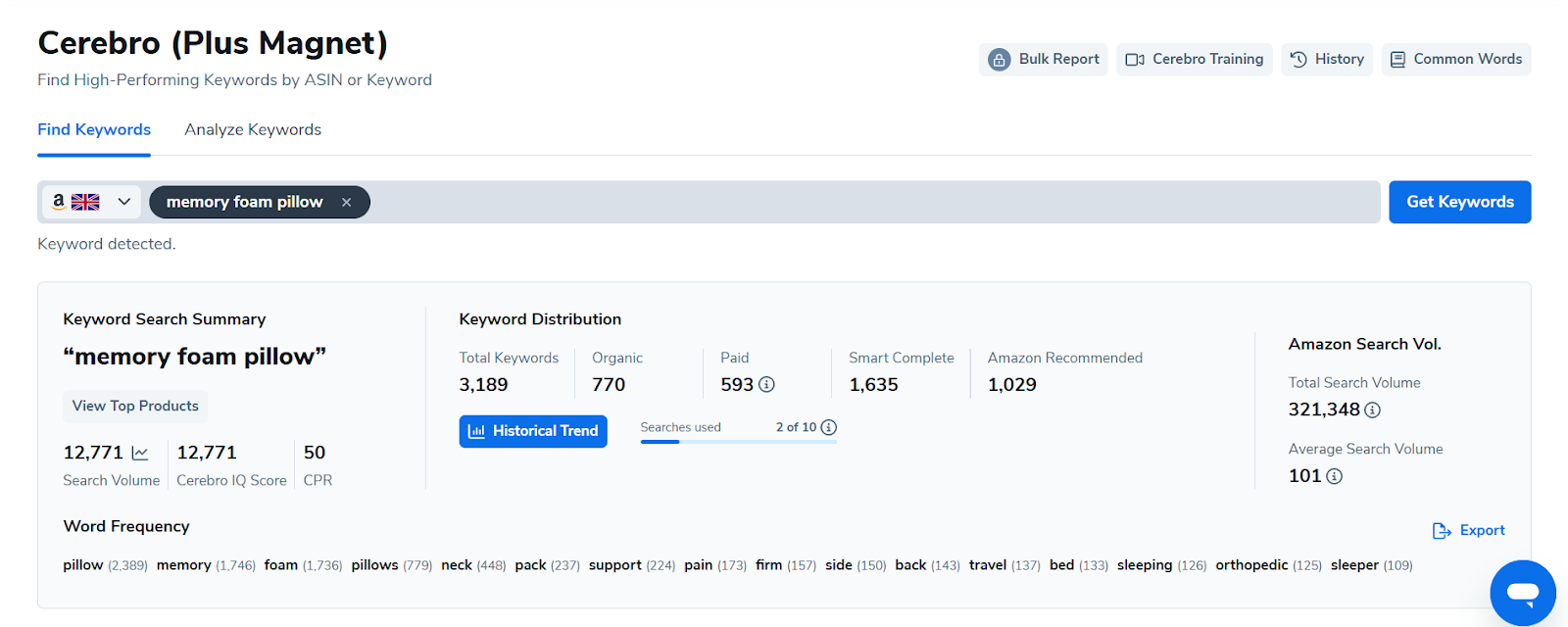
Enter a high-level seed keyword into your Amazon SEO tool (e.g. Helium 10 Cerebro, JungleScout, MerchantWords). This should have a very broad definition - the most simple and common way to describe the product type is usually a good place to start.
-
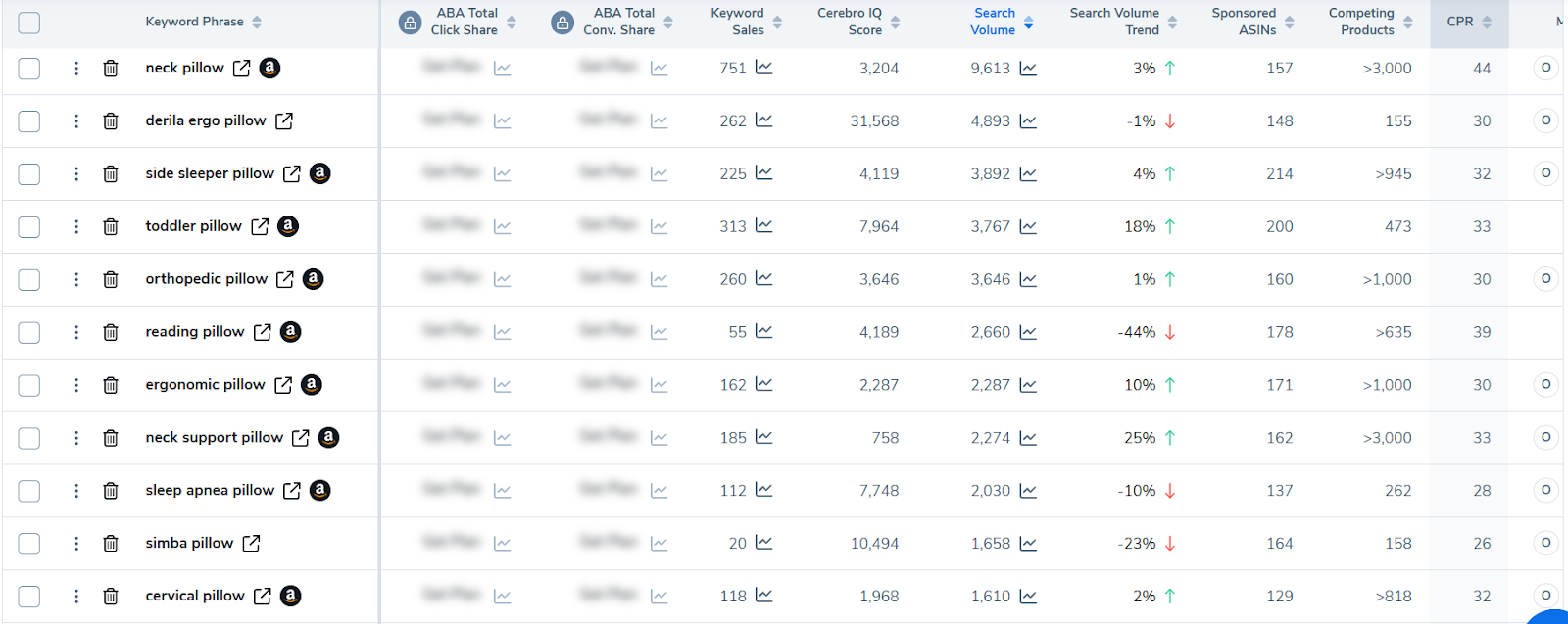
Analyse the keyword volume of all the keyword suggestions your tool returns.
-
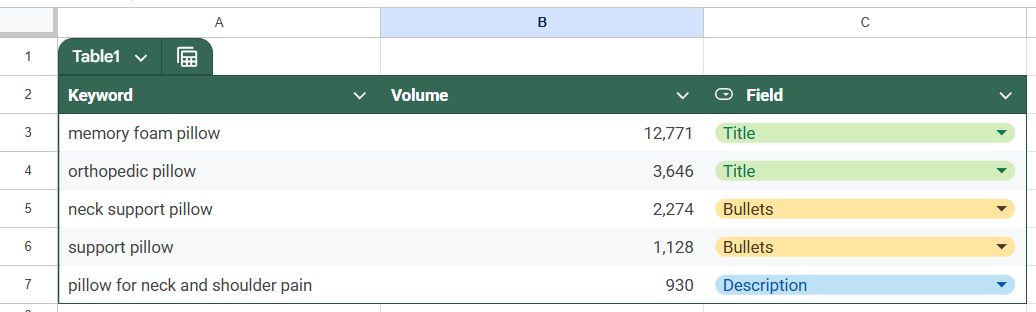
Enter the keywords you’ve selected in a keyword into a table for field mapping, with the columns: keyword, volume, and field.
Here’s an example of how to carry out your keyword research using Helium 10:
Step 1: Entering a product seed keyword (“memory foam pillow”).
Step 2: Reviewing suggestions
Step 3: Mapping keywords
2. Amazon Title Optimisation
Your title is the strongest relevance signal when it comes to Amazon SEO optimisation, so it’s crucial to get this part right.
Here’s some best practices to follow when writing your product titles:
Remember Amazon Requirements
As of July 2026, Amazon titles are split into two separate parts: the title, and the "item highlights", a section that sits immediately below the title on Amazon search results and is intended for you to list features and use cases.
The title gives you 75 characters maximum, while the item highlights has a limit of 125 characters, adding up to the old limit of 200 characters.
With Amazon's increasing emphasis on AI-powered search, keywords are still important. However, it will probably become increasingly crucial to make sure your titles are structured in a way that's easy for AI to understand, and match with the more detailed queries shoppers will use to search.
Keep It Scannable
Your title’s structure should be simple and easy to scan, but not so stripped-down that it comes off as keyword-stuffed and overly promotional.
An effective structure we apply in our content optimisation projects is:
Title:
[Brand Name] + [Primary Keyword] + [Main Differentiator USP]
Followed by item highlights that balance secondary keyword inclusion with more precise details and use cases that will help AI search understand the product.
In our example with the memory foam pillow, the optimised title might look like this:
BlueSleep Memory Foam Pillow With Hypoallergenic Cooling Cover, 60 x 35 cm
And its item highlights might look like this:
Shredded Memory Foam Filling, Relieves Neck and Shoulder Pain, With Breathable, Machine-Washable Cover
Create Some Alternative Titles for Testing
Best practices can get your Amazon SEO strategy off to a good start, but different audience segments can respond more or less favourably to different content.
A/B testing different title structures can both highlight what’s working for this specific ASIN, and help you find patterns in engagement that you can apply to the rest of the catalogue.
Some elements you might want to test include:
- Front-loading vs late-title keyword placement.
- Framing different USPs in the item highlights.
- Feature-focused vs outcome focused item highlights.
- Shorter (50-75 character) titles vs longer (100-125 character) item highlights.
3. Amazon Bullet Point Optimisation
Bullet points are a major predictor of your product’s conversion rate, which in turn has a big influence on Amazon organic rankings. This is where you can showcase the product’s main features and benefits, and overcome any friction or objections that might prevent a conversion.
The key best practices to bear in mind when writing product bullets are:
- Use each bullet to pair a product feature with a tangible benefit this feature offers.
- Include target keywords that didn’t make it into the title, while maintaining natural language and writing style.
- Try to address common buyer objections as much as possible, e.g. sizing, compatibility, maintenance.
- Mention trust signals like industry body certifications or where the product is manufactured, while taking care to avoid violating Amazon policies.
Here’s an example of how to write Amazon bullets for our memory foam pillow:
COOLING MEMORY FOAM: The pillow’s breathable, heat-dissipating memory foam regulates your body temperature to help you stay cool and comfortable all night long, ideal for hot sleepers.
ORTHOPEDIC DESIGN: Made specifically to support proper spinal alignment, this neck support pillow minimises strain on your body’s pressure points to help reduce stiffness.
ADAPTIVE CORE: The pillow’s adaptive core moulds around your head and neck and bounces back after use, preventing flattening and ensuring consistent support night after night.
REMOVABLE CASE: The zip-up cover can be removed and machine-washed quickly and easily, keeping the pillow fresh and easy to maintain.
OPTIMISED SIZE: The 50x75cm profile reduces the need for awkward repositioning during sleep and provides consistent support even when shifting positions, helping you stay comfortable for longer.
4. Amazon Product Description Optimisation
The product description on your Amazon listing is the longer copy field with a limit of up to 2,000 characters. If you use A+ content (which you should wherever possible!) this listing element will override the product description and it won’t be visible to Amazon users.
Despite this, Amazon will still crawl the copy in your product description for keywords, and future updates might see a visible product description becoming a universal feature again.
This field is the ideal place to reiterate the key features and benefits of the product, while also using longer, more developed copy to tell your brand’s story and speak freely in its unique tone of voice.
You should also try to include any long-tail keywords that you weren’t able to use naturally in the titles and bullets. Note that Amazon’s algorithm tends to rank products for keywords in the product description more consistently when there’s some overlap with keywords included in the title and bullets.
For example, optimising the product description for the keyword “pillow for neck and shoulder pain” will maximise its visibility for this long-tail keyword as the word “pillow” is already included in the title and bullets.
5. Amazon Backend Keywords Optimisation
A listing’s backend keywords aren’t visible to Amazon users, but they’re still essential for full Amazon SEO optimisation.
Amazon backend keywords are one of the more misunderstood fields in an Amazon listing, and the way the A10 algorithm crawls it can be a little complicated.
Here’s some of the key points to remember about optimising this field:
- The backend keywords field is limited to 250 characters.
- There’s no need to use commas to separate words.
- Amazon reads the contents of the backend keywords as individual words, not phrases. For example, entering “pillow for side sleepers” will optimise the field for the words “pillow”, “side”, and “sleepers”, but not the whole phrase, making the word “for” redundant.
- Because the A10 algorithm isn’t affected by keyword density, there’s no advantage to repeating words in the backend keywords that you’ve already included in the title and bullets, and this will only use up valuable characters.
- Amazon will ignore any competitor brand names its algorithm recognises that are entered into the backend keywords. However, you can still optimise for competitor brand names that happen to use common words, (e.g. bubble or air) or common names (e.g. Smith, Daniels).
6. Build Product Reviews (Compliantly!)
In the long-term, doing everything you can to accumulate Amazon reviews (while staying compliant with Amazon policies!) is another crucial way to boost your organic visibility and maximise sales.
Here are some of the best ways to achieve this while staying on the right side of Amazon’s rules.
Amazon Vine: The Amazon Vine program is the principal Amazon-approved method to get reviews for your product. With this program, you send free products to vetted Vine members in exchange for unbiased reviews, helping you build social proof quickly.
Request a Review Button (Seller Only): Seller Central’s “Request a Review” feature allows you to send out a neutral message asking for a product review and brand feedback once per order within 5-30 days of delivery. As another official Amazon tool, this method carries no risk of policy violation. It can also be automated using certain approved third-party tools.
Product Inserts: While product inserts are allowed by Amazon, you’ll need to follow strict rules when deploying them. A simple, neutral “we’d love your honest feedback” is fine, as are QR codes linking to your customer support page. However, incentivising reviews, review gating, or asking specifically for positive reviews will swiftly get you penalised.
Amazon SEO FAQs
Though organic search is just one part of a comprehensive Amazon marketing strategy, getting it right can go a long way to help you reduce reliance on paid advertising, improve trust in your brand, and start building sales velocity for long-term success.
We’ll wrap up with some frequently asked questions you can use as a quick reference while you get started optimising your listings. For more support with your organic Amazon marketing, be sure to check out our other blog posts, or discover how our ContentStudio services can help you today.

What is Amazon SEO?
Amazon SEO is the process of optimising your product listings so they rank higher within Amazon’s internal search results. This step is critical, as a significant proportion of ecommerce shoppers begin their product searches directly on Amazon rather than on traditional search engines.
Strong Amazon SEO ensures your products are visible to high-intent shoppers who are ready to buy, helping you increase organic traffic, reduce reliance on paid ads, and drive sustainable revenue growth.
What is the Amazon A10 algorithm?
The Amazon A10 algorithm is the unofficial name given to the current iteration of Amazon’s search ranking system, which evolved from the earlier A9 framework.
The Amazon A10 algorithm evaluates listings across three main pillars:
- Relevance (keyword placement, categorisation, compliance).
- Catalogue health and operational readiness (media quality, valid identifiers, policy adherence).
- Performance metrics (conversion rate, sales velocity, reviews, fulfilment reliability).
Unlike Google, Amazon’s algorithm is designed to prioritise listings that are most likely to generate profitable transactions for the platform.
How is Amazon SEO different from Google SEO?
Amazon SEO is fundamentally conversion-driven, whereas Google SEO caters to a broader mix of informational and commercial intent.
Google also has a more diverse range of ranking signals, compared to Amazon which is singularly focused on helping shoppers find the product they’re looking for.
For example, Google relies heavily on backlinks and domain authority as ranking signals. Amazon, on the other hand, uses sales performance, conversion rate, and customer satisfaction metrics as trust indicators.
This means your Amazon strategy should focus less on content breadth and more on conversion optimisation, listing structure, and operational excellence.
How long does it take to see results from Amazon SEO?
There is no fixed timeframe, as results depend on competition, pricing, stock availability, and how well optimised your listing is from launch.
That said, improvements in click-through rate and conversion rate can lead to ranking improvements within just a few weeks, particularly if supported by paid advertising to stimulate early sales velocity.
Like anything in marketing, Amazon SEO is not a one-off task - continuous optimisation and testing are required to maintain and improve rankings over time.
Are backend keywords still important?
Yes, backend keywords remain an important part of Amazon SEO optimisation.
Although they are not visible to shoppers, they help Amazon’s algorithm understand additional search terms your product is relevant for. However, the backend field is limited to 250 characters, and repeating keywords already used in your title or bullets offers no benefit.
Effective backend optimisation is about maximising discoverability without duplication.