
.jpg)
If you’ve been operating on Vendor Central for a while, you won’t need us to tell you that what Amazon pays is rarely as straightforward as the value of the invoices you send.
The commercial terms you agreed with Amazon, deductions from Vendor CoOp agreements, returns, pricing adjustments, and operational deductions are all variables that can affect the true value of the payouts you get from Amazon.
Shortage claims and chargebacks are two types of deductions that tend to get particular attention, as they’re both common, and difficult to understand and resolve at scale. Many teams also have a habit of wrapping them up into a single, annoying category: Amazon has taken money they shouldn’t have, and now it’s your job to get it back.
However, framing Amazon deductions as one problem with one solution could be costing you money.
Varying causes, evidence, and resolution paths all create important distinctions. Misclassifying deductions that show up on your radar can lead to wasted investigation time, weak disputes, missed deadlines, and deductions that keep popping up again and again because you haven’t found a permanent fix.
And all that could be costing you money - potentially a lot more than you might think.
In this guide, we’ll explore why categorising chargebacks matters, and the true extent of how much it could be costing you. Finally, we’ll explain how to build a functional workflow that adapts to each deduction type and minimises the negative impact of deductions as a whole.
Why the Shortage Claims vs Chargeback Distinction Matters
Though both shortage claims and chargebacks both result in Amazon taking money off the amount they pay you after invoicing, they operate in very different ways.
Chargebacks, the most common type of deduction, are raised as financial penalties for Vendors who make errors during the fulfillment process, for example failing to package shipments in-line with Amazon guidance or not submitting the required documents.
Shortage claims, on the other hand, are raised specifically when Vendors fail to send the amount of units they’d agreed to in a purchase order (PO).
Once you have an understanding of how different each type of deduction is, it becomes clear that a single standard workflow can struggle to handle both types.
A common one-size-fits-all workflow might look like this:
1. Export deductions from Vendor Central.
2. Gather the invoices they relate to.
3. Submit your disputes, often in bulk.
4. Wait for a resolution and follow up on any rejections.
The appeal of this method is obvious, making the process simple, repeatable, and easy enough to hand over to junior team members. Sadly, like a lot of things with Vendor, things aren’t always that simple.
While this cycle can work reasonably well when a deduction is essentially rooted in a paperwork mismatch, it can quickly fail when the evidence you’re gathering doesn’t address Amazon’s actual reason for the deduction.
Consider these two examples:
A chargeback for a non-scannable carton label - Attaching the invoice proves that you billed correctly, but doesn’t confirm anything about the label. Amazon’s allegation begins and ends with labelling, and the invoice doesn’t address this.
A shortage claim caused by a barcode configuration error - A stack of compliance paperwork doesn’t address the quantity relationship between what you shipped and what Amazon actually scanned. If the barcode in the catalogue doesn’t match the barcode on the actual goods, reconciliation needs to emphasise this.
A scattergun approach, where you simply find an invoice and dispute it, could end up serving neither type of deduction particularly well. This approach generates activity, which may feel like progress, but produces weak disputes, which only reinforces the incorrect notion that Amazon is impossible to argue with.
A more targeted and specific approach: classify and investigate first, dispute second, will clearly distinguish which claims to fight and which ones to leave.
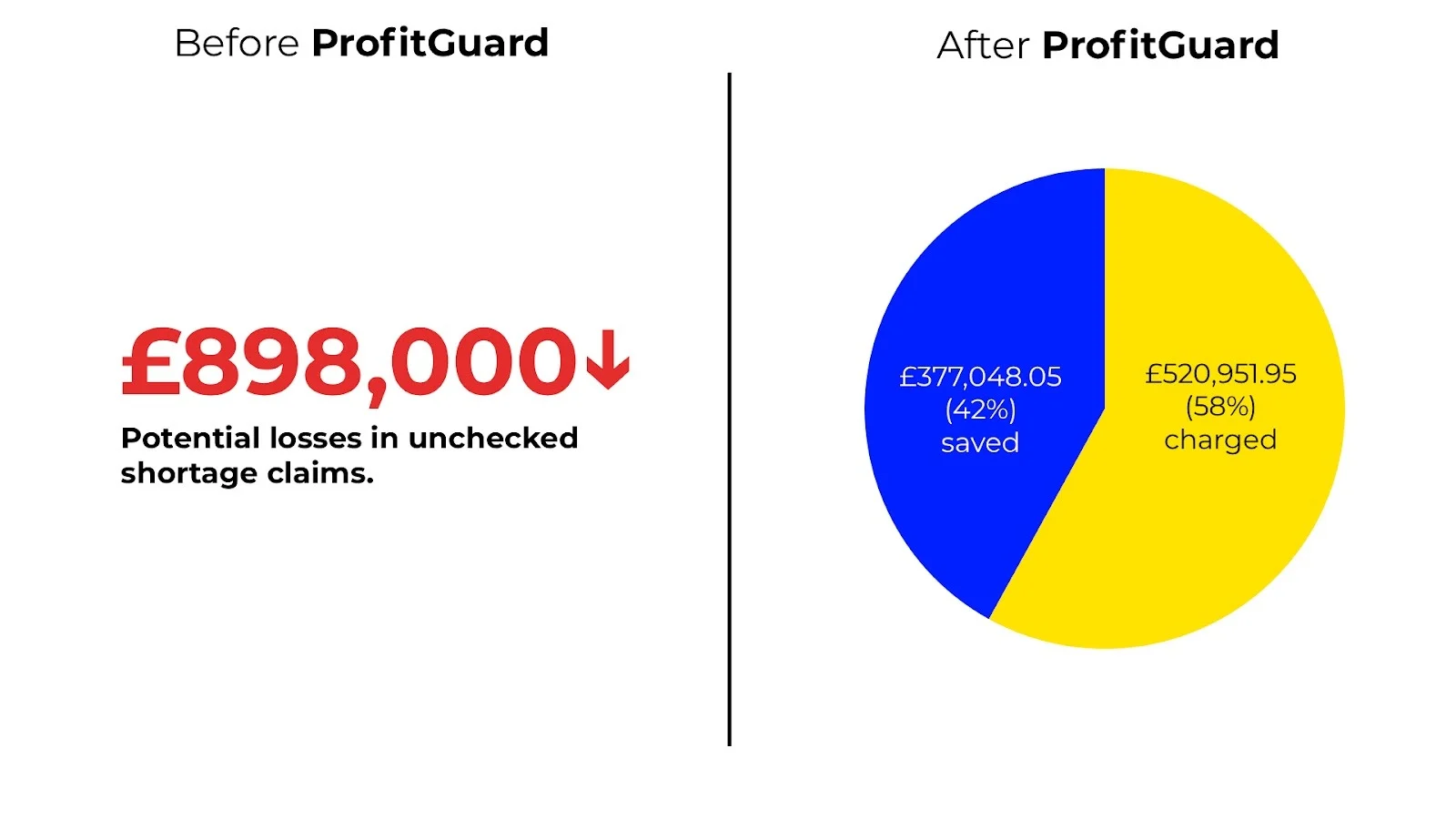
Our deduction recovery work with General Mills revealed the importance of strong auditing and separating Shortage Claims from Chargebacks. Read the full case study here.
The Evidence is Different, Which is Where Teams Go Wrong
Because chargebacks and shortage claims ask different questions, they require different proofs to tackle.
Here’s a side-by-side comparison that illustrates the contrast for each one:
.jpg?width=1200&height=670&name=Blog%20Post%20Image%20(17).jpg)
Some key things to note here:
The records are different in kind: Shortage claim management is dominated by transactional records. The chargeback side, on the other hand, depends more on operational records, with photos, scan logs, carrier communications, booking histories, and quality checks. These are often held by different teams, in different systems, and with different retention habits.
The unit of analysis differs: Shortage claims are analysed per shipment, PO, or invoice, because they’re quantity gaps on a specific consignment. Chargebacks are often analysed per requirement, because the same requirement could have been breached across several different shipments, which can impact how you look for patterns.
Success is defined differently: For shortage claim disputes, success is generally a corrected balance. With chargebacks, on the other hand, success can be a corrected balance, a fixed process, or both. A valid chargeback is a signal that your process needs work.
It’s worth noting here that real-world deduction cases can overlap. A mislabelled carton, for example, can potentially trigger both a carton-information chargeback and a shortage claim, as a label that Amazon can’t scan may mean that units won’t be logged as received.
Two deductions from a single root cause is entirely plausible, and the classifications you make should always be informed by investigations, rather than assumptions. The label on a deduction tells you where to start looking, but not where your investigation will finish.
Why Misclassification Gets Expensive
The true cost of misclassifying Amazon deductions isn’t something you can attribute to one big mistake. Rather, it accumulates through a series of smaller ones.
Here’s a look at the four main ways that getting classification wrong can cost you money.
Assigning the Investigation to the Wrong People
Shortage issues can require finance, accounts receivable, or supply-chain reconciliation skills: access to invoicing data, PO history, and Amazon receipt records, as well as the ability to line up disparate data points.
Chargebacks can require input from operations, logistics, warehouse, packaging, or compliance teams - the people at your company who know how cartons are labelled, how carriers are booked, and how a packaging line runs.
If everything gets routed to a single team, a couple of things happen: the team is stretched across problems they’re not fully equipped to solve, and all your Amazon deductions wait in a queue behind others that are quicker and easier to process.
A finance person having to figure out why a carton label failed will spend a lot of time getting information from people in the warehouse, and a warehouse manager asked to reconcile a quantity discrepancy could spend a lot of time chasing finance for the relevant figures. The investigation slows, and the dispute window keeps ticking away.
It Leads People to Gather the Wrong Evidence
A shortage dispute supported by compliance documentation won’t be able to establish a quantity discrepancy, just like a chargeback dispute supported only by invoices won’t be able to prove operational compliance.
In either case, the dispute isn’t going to engage with Amazon’s actual reason for raising the deduction. Someone assigned to review it will need proof of one thing and will be gathering proof of another, most likely resulting in a rejection.
Without clearly distinguishing the two types of Vendor Central deductions, your team could be left pursuing a string of disputes in a way that invariably ends with a rejection. Each rejection costs time that could be invested elsewhere, and shortens the limited window you have to dispute.
It Creates False Confidence
A recovered deduction, especially if the dispute was accepted by Amazon accidentally, can make existing processes appear successful when the operational issue that caused it still remains. If a team is pleased with a high recovery rate on chargebacks, without fully investigating why the chargebacks occurred, they may well be congratulating themselves for solving an issue that they’re unknowingly creating.
The reverse of this is also true. A rejected shortage dispute can often be caused by an incomplete reconciliation, instead of a claim that’s totally unrecoverable. Perhaps the wrong shipment was referenced, a partial receipt wasn’t considered, or a catalogue mismatch wasn’t identified.
Lacking foolproof classification and a well-structured investigation, a team might conclude that Amazon won’t budge, close the case, and leave recoverable money on the table. We often work with brands who have spent a long time attempting disputes without a framework for separating recoverable claims from those they can leave alone, something which can be resolved by a well-structured audit.
Need better visibility on your Vendor deductions? Our ProfitGuard service starts with a free, zero-risk audit, so you can determine exactly how much profit you’re losing out on.

It Gets in the Way Of Root-Cause Analysis
If every deduction is lumped in the same bucket, then your visibility into the issue is going to be severely limited. You won’t be able to see recurring patterns, e.g. if 60% of your chargebacks all involve the same warehouse, or that your shortage claims are clustered around a single product family or receiving facility.
To learn from Amazon deductions, and reduce their impact on your bottom line in the long term, you need to pursue three distinct goals:
Money recovery: Actually retrieving the amount that was wrongfully deducted.
Process correction: Fixing what went wrong on your side.
Prevention: Making sure that a specific problem doesn’t come up again.
Though these goals are related, they’re not the same. Recovery is a finance outcome, correction is an operations outcome, and prevention is a management outcome. When they’re all piled into the same category, the variables of each goal become blurred, and you’ll confuse future attempts to figure out where these deductions are coming from in the first place.
The Financial Impact Goes Beyond the Original Deduction
When teams total up what their deductions cost, they often look at the amounts given on the statement. But that’s only one small part of the overall picture.
Often, the real cost of Amazon deductions have less obvious causes, which you’ll still need to investigate if you really want to minimise your losses.
The financial impact of Amazon deductions can be classified into one of three groups:
Direct Financial Impact
The direct costs of a chargeback or shortage are the easiest to see.
The deduction amount itself: The money Amazon has told you they’ve withheld.
Internal working hours: Finance teams, warehouse staff, and operations managers who are investing time investigating and disputing individual cases.
Time spent gathering documentation: Chasing carriers, pulling records, taking screenshots and assembling a folder of evidence.
Potentially unrecovered amounts: Money that’s genuinely owed to your company, but abandoned, either because the window closed or the effort to reclaim it exceeds the perceived return.
Indirect Operational Impact
Indirect operational costs tend to be harder to measure, but are often even more significant than the more obvious direct costs.
Repeated investigations: The same root cause gets investigated each time it produces a deduction because nobody linked the cases when the first few came up.
Cross-functional handoffs: Handoffs between finance, warehouse, and operations teams create delays, and increases the risk of information being lost.
Delayed reconciliation: Open deductions make month-end and quarter-end reporting slower, and the impact-over-time harder to articulate.
Reporting inaccuracies: Margins by product or account may look better or worse than the reality, depending on whether each deduction has been booked, disputed, or recovered.
Time diverted from high-value activities: The work required to dispute chargebacks, especially if your approach isn’t systematised, takes away bandwidth from other activities that can be used to develop the business further.
Recurring Deduction Impact
Every Vendor deduction you attempt to dispute will have one of two outcomes:
- Recovering money from an individual deduction - a one-off win, however welcome that may be.
- Eliminating the process failure that’s causing repeated deductions - an achievement that will keep on saving you money, month after month.
This is where the concept of cost-per-root-cause can become valuable. Instead of simply looking at the monetary amount of each deduction, ask what each underlying cause costs across all the deductions it generates, including the investigation time and lost recoveries.
Imagine a quarter where you receive 40 small chargebacks, all of them too small to justify the effort of a dispute. Judged individually, each chargeback is a shrug.
However, if you then trace all 40 back to a single label-printing setting in a single warehouse, you’re prompted to consider another maths problem: what is that one setting costing us?
A single fix here could potentially remove 40 recurring deductions, plus the investigation time and admin overhead that each one could have potentially cost.
Measured by the root cause, this action gives you one of the best returns available, while measured per deduction it’s almost invisible.
A Better Amazon Deduction Triage
Classifying Vendor Central deductions is the first crucial decision point in controlling their impact, but a triage is the process that makes it reliable and repeatable.
Here’s how to build a better Amazon deduction triage at your organization:
Step 1 - Build a Classification Layer
Before you assign a deduction to an owner, it’s important to make sure you’re capturing a consistent set of information for each instance.
A useful framework includes:
- Deduction type.
- Reason code.
- PO, shipment, and invoice relationship.
- Amount.
- Date.
- The specific rule Amazon says was breached (if applicable).
This information can be kept in a spreadsheet, a set of fields in your finance system, or a tab in a shared workspace. The important thing is that it exists, that it’s consistently filled at the point of intake, and that each classification is handled by someone with enough knowledge to do it reliably.
Step 2 - Route Based on the Underlying Problem
Once a deduction is classified, it should be routed to the team best-equipped to investigate it.
For a shortage-to-reconciliation workflow, this might include finance or accounts receivable, supply chain, or receiving and shipping teams.
For a chargeback-to-compliance workflow, this might include operations, logistics, warehouse, and compliance.
The exact ownership of the issue will of course vary from one organisation to the next, but the key principle is that routing follows the type of problem, not just whoever happens to spot the deduction first.
Step 3 - Standardise Evidence Requirements
You should have separate, standardised evidence checklists for shortages and chargebacks, so teams aren’t forced to start every investigation from scratch.
Here’s a checklist template for each type of deduction to consider:
Shortage Claim
- PO, with ordered and accepted quantities.
- Any approved adjustments or cancellations.
- ASN for the specific shipment.
- Packing list and shipment confirmation.
- Carrier documentation and proof of delivery.
- Invoice, with invoiced quantity.
- Amazon's received quantity and receipt dates, by location.
- Catalogue and package hierarchy data for the ASINs concerned.
- A completed reconciliation chain.
Chargeback
- Chargeback type, date, shipment and amount.
- The specific Amazon requirement that applied at the time.
- Evidence of compliance (labelling and packaging documentation, booking records, carrier records).
- Internal warehouse or fulfilment records (quality checks, sign-offs).
- ASN and documentation records.
- A determination: incorrectly assessed, or process failure?
- Corrective action, if the process did fail.
Standardised checklists reduce dependence on the knowledge of an individual team member, speed up handovers, and make the data more easily reviewable. Furthermore, standardised checks can help to highlight gaps. If a required record simply doesn’t exist, that’s an important finding in itself.
Step 4 - Track Outcomes Past “Won” or “Lost”
In a lot of organisations, tracking deductions stops at a simple “won” or “lost” status, but tells you almost nothing about what needs to be done next.
You can build a more complete picture of how deductions are affecting your organisation and being handled with richer outcome classifications, for example:
Valid deduction - Amazon was right.
Invalid deduction - Amazon was wrong and the case was disputed.
Insufficient evidence - Possibly invalid, but the available records couldn’t prove it.
Process failure - The deduction was valid, due to an operational breakdown on your side.
Documentation failure - The process was fine, but the records that prove it weren’t retrievable.
Prevented recurrence - A corrective action was taken and the underlying issue has stopped.
Applying these categories will turn your deduction investigation into an operational feedback loop, where “insufficient evidence” tells you your record-keeping needs to improve, “process failure” routes the work to operations, and “prevented recurrence” is the outcome you want to see growing.
Having this outcome tracking in place lays essential groundwork for long-term improvement and more saved revenue.
Maximising Revenue With Better Classification
Shortage claims and chargebacks often pop up looking alike, but handling them alike creates poor-quality evidence gathering, incorrect ownership, and the wrong corrective action, all of which could be costing you money.
Your goal moving forward shouldn’t be to simply file as many disputes as possible, but to wrangle the chaos of Amazon deductions into a more logical system:
Investigate each deduction with the right lens and the right evidence. Route it to the right team. Dispute only what needs to be disputed, using evidence that actually answers the alleged issue. Finally, fix the broken processes on your side, and measure whether the fixes worked.
Vendors who build and refine a system like this will not only be able to recover more deductions, but enjoy a smaller deduction problem in the long term.
For more support with optimising your Vendor operations for profit, be sure to check out our other blog posts, or book a free, no-risk ProfitGuard audit to see how much Amazon owes you.

Shortage Claims vs Chargebacks FAQs
Why shouldn’t shortage claims and chargebacks be handled the same way?
They involve different causes, evidence, owners, and resolution processes. Shortage claims usually require transactional reconciliation, while chargebacks often require operational or compliance evidence. Treating them identically can lead to weak disputes and wasted investigation time.
What evidence is needed to dispute a shortage claim?
Shortage investigations typically rely on the PO, ASN, packing and shipment records, carrier documentation, invoice, Amazon receipt data, and relevant catalogue or package hierarchy information. The aim here is to establish a clear chain between what was ordered, shipped, invoiced, and received.
What evidence is needed to dispute an Amazon chargeback?
The evidence depends on the requirement involved but may include packaging or labelling records, booking and carrier documentation, warehouse quality checks, photos, scan logs, ASNs, and other proof of compliance with Amazon’s requirements.
Can one issue cause both a shortage claim and a chargeback?
Yes. For example, a barcode or carton-labelling problem could trigger a chargeback while also preventing Amazon from correctly recording received units. Each deduction should therefore be investigated based on its underlying cause rather than its label alone.
How can misclassifying deductions cost money?
Misclassification can send cases to the wrong team, result in irrelevant evidence being gathered, increase rejection rates, consume dispute time, and obscure recurring operational problems. It can also leave genuinely recoverable deductions unresolved.